An EPDM gasket that swells, softens, or leaks within weeks of installation is almost always a chemical-compatibility failure, not a manufacturing defect: EPDM absorbs petroleum oils and fuels, and even trace contact — a drip of engine oil migrating across a flange face during a fluid change — is enough to swell the compound and permanently loosen the seal. Confirming EPDM is the right rubber for a joint’s actual fluid exposure, not just its temperature or pressure rating, is the first step before sourcing it. That starts with understanding what the material actually is, what the acronym means, what it’s made of, and how it compares to a non-rubber alternative like PTFE.
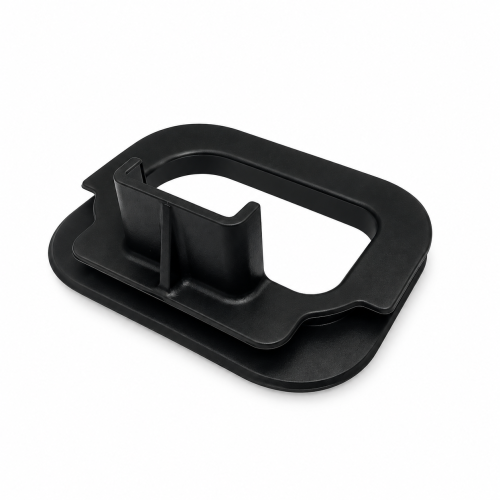
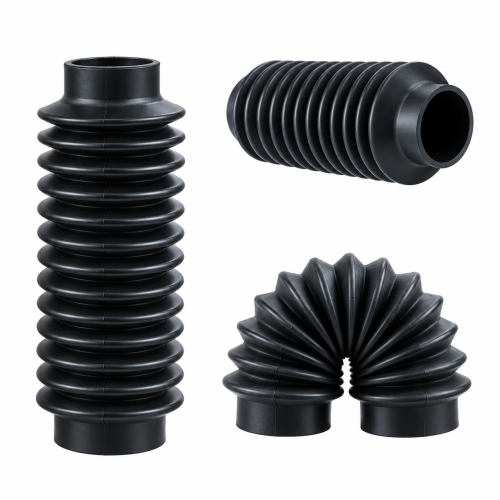
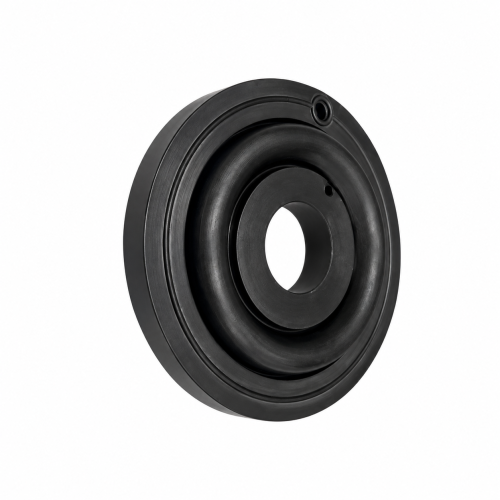
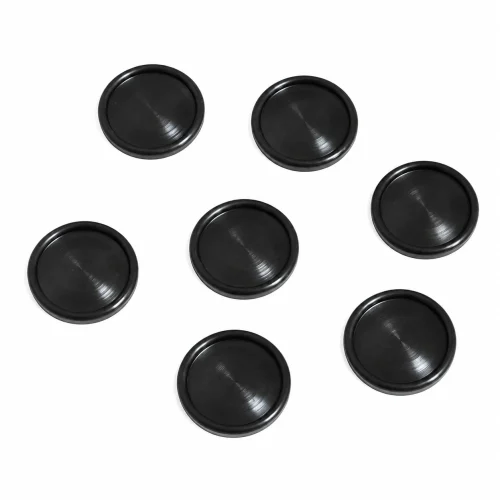
An EPDM gasket is a sealing component molded, die-cut, or extruded from ethylene propylene diene monomer rubber — a synthetic elastomer valued for its resistance to weather, ozone, UV exposure, and steam. Because it holds up outdoors and in hot-water systems without cracking or hardening the way many general-purpose rubbers do, EPDM gaskets show up in automotive weatherstripping, HVAC duct connections, plumbing fixture seals, and outdoor equipment enclosures.
EPDM stands for Ethylene Propylene Diene Monomer. It’s a terpolymer — a polymer built from three monomers: ethylene and propylene form the saturated backbone that gives EPDM its ozone and weathering resistance, while a small amount of diene monomer is added specifically to provide the double bonds needed for sulfur cross-linking (curing) during vulcanization.
The base polymer is a copolymer of ethylene and propylene, with a diene monomer (commonly dicyclopentadiene, ethylidene norbornene, or 1,4-hexadiene) copolymerized in to create cross-linking sites. Compounders then cure the raw polymer using either a sulfur-based system or a peroxide-based system. Peroxide curing produces a compound with better high-temperature and steam resistance, while sulfur curing is more common for general-purpose, lower-cost gaskets. Fillers such as carbon black adjust hardness, cost, and reinforcement, and plasticizers or processing oils are added to control flexibility — though oil-based plasticizers must be chosen carefully, since EPDM’s own resistance to oils is limited.
EPDM and PTFE solve different sealing problems, and the choice usually comes down to chemical exposure and flexibility needs.
| Attribute | EPDM | PTFE |
|---|---|---|
| Composition | Synthetic terpolymer rubber (ethylene, propylene, diene) | Fluoropolymer (not a rubber; semi-crystalline plastic) |
| Typical temperature range | ~-50°C to 150°C | Roughly -200°C to 260°C, generally wider than EPDM |
| Chemical resistance | Good with water, steam, polar fluids; poor with oils and fuels | Resists nearly all chemicals, acids, and solvents |
| Flexibility / compressibility | Elastic, conforms well to surface irregularities at moderate bolt load | Stiff and prone to cold flow; often needs a filler or envelope design to seal well |
| Typical cost | Lower material cost | Higher material cost, especially for filled or envelope grades |
| Typical use case | Outdoor seals, HVAC, plumbing, automotive weatherstripping | Aggressive chemical processing, high-purity or high-temperature piping |
In practice: choose EPDM when the joint sees water, steam, or weather but not oils or fuels, and when the gasket needs to compress and conform to an imperfect flange. Choose PTFE when the media is chemically aggressive or the operating temperature exceeds EPDM’s range — accepting that PTFE gaskets need more careful bolt-load control because the material doesn’t recover elastically the way rubber does.
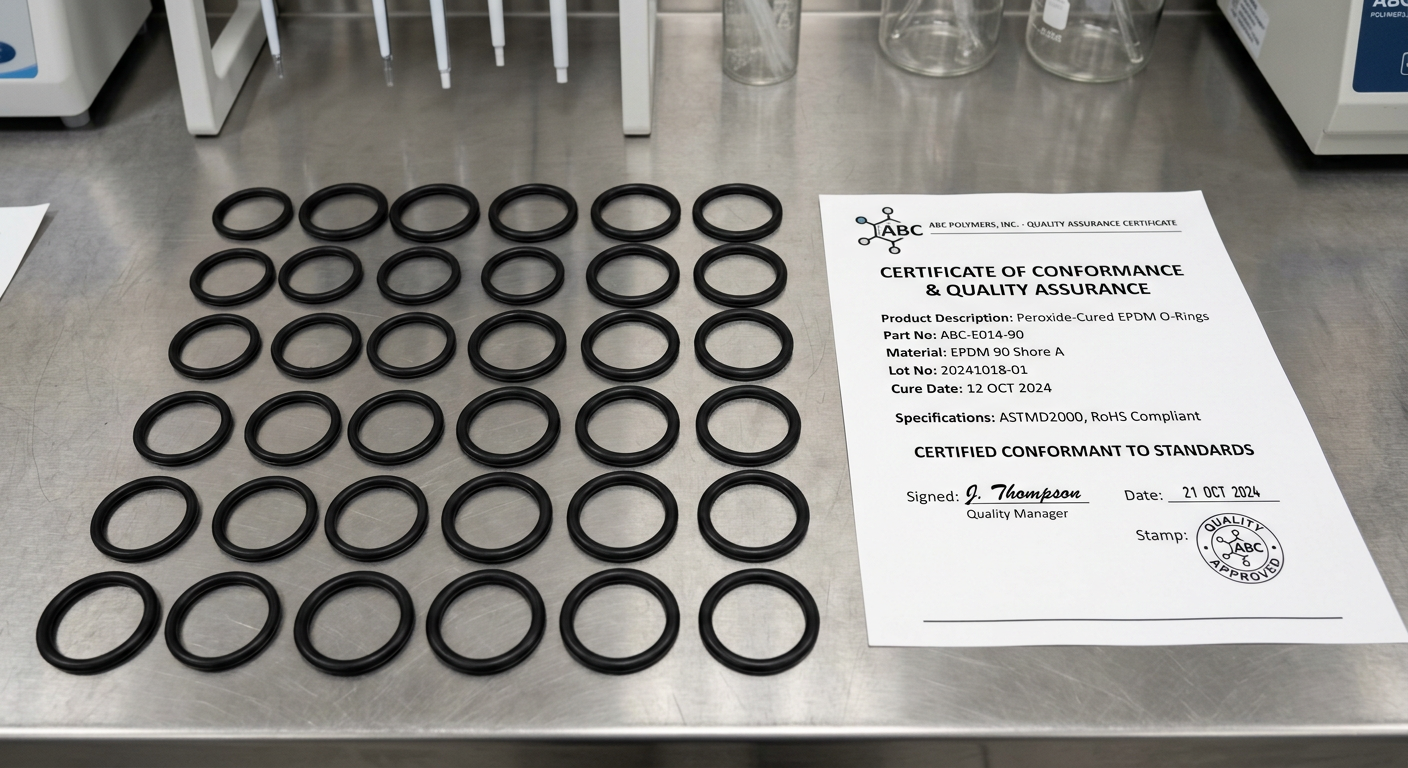
EPDM gaskets are generally supplied in the 40–80 Shore A durometer range, with softer compounds conforming more easily to uneven flanges and harder compounds holding shape better under pressure. Cure system drives compression-set behavior directly: peroxide-cured EPDM typically posts compression-set values in the 15–25% range under ASTM D395 Method B testing (22 hours at 100°C), while sulfur-cured EPDM commonly runs higher, in the 25–35% range. That gap is why peroxide cure is preferred for joints that need to hold bolt-load sealing force through years of thermal cycling — a rooftop HVAC duct flange or an outdoor junction-box cover are typical examples where this matters. Sheet and molded gaskets are available across a range of thicknesses to match groove depth or flange gap, and compound formulators reference the relevant ASTM D2000 rubber classification when specifying an EPDM grade for a given temperature and fluid exposure. Exact figures vary by compound and should be confirmed against a supplier’s material data sheet rather than assumed from general ranges.
Service life depends on compression level, chemical exposure, cure system, and thermal cycling rather than a fixed number of years. A properly compressed EPDM gasket kept within its chemical and temperature limits — away from oils and fuels — commonly lasts for years in static outdoor or water/steam service. Gaskets that see intermittent oil contact, excessive compression, or temperatures near the upper end of the range will degrade faster and should be inspected on a schedule rather than assumed to last indefinitely.
EPDM is generally rated for continuous service from roughly -50°C up to about 150°C, with peroxide-cured compounds tending to hold up better at the higher end of that range than sulfur-cured ones. This is a material-family range, not a guarantee for every compound — always check the specific grade’s data sheet, since fillers and cure system shift the practical ceiling.
Once EPDM’s chemical resistance and temperature range fit the application, the next step is turning a drawing into a molded or die-cut part. Hongjie Sealing Technology is IATF 16949:2016 and ISO13485:2016 certified, works with FDA- and NSF-compliant materials, and produces gaskets by both compression molding and injection molding from CAD drawings through mass production, with functional prototypes available in 3–5 business days. Explore EPDM Rubber Gaskets for standard and custom EPDM gasket options, or start a project through Hongjie’s contact page.
For a full breakdown of what drives per-unit and tooling pricing, see EPDM gasket cost guide. If EPDM turns out to be the wrong fit for oil or fuel exposure, neoprene rubber gaskets cover that gap, and for a broader look at gasket materials beyond EPDM, the types of rubber gaskets overview covers the full material lineup.
Buyers evaluating chemical resistance beyond EPDM’s oil and fuel limits can compare FKM/Viton compounds in Viton O-Rings (FKM/FFKM), and those weighing gaskets against other sealing components — grommets, bushings, bonded parts — can review the trade-offs in grommets vs alternatives.
Need a quote on a custom EPDM gasket drawing? Contact Hongjie’s engineering team to start.
Why do EPDM gaskets fail after contact with oil or fuel?
EPDM’s saturated hydrocarbon backbone absorbs petroleum-based oils and fuels rather than resisting them, causing the rubber to swell, soften, and lose its sealing force. Even brief or incidental contact — a drip during a fluid change — can trigger enough swelling to compromise the seal permanently, which is why EPDM is reserved for water, steam, and weather exposure rather than oil-side joints.
How is an EPDM gasket different from a neoprene gasket?
Both are synthetic rubbers, but EPDM has better weathering, ozone, and steam resistance, while neoprene handles oils and fuels better. For applications with any petroleum-based fluid contact, neoprene rubber gaskets are usually the better fit.
How much do EPDM gaskets cost?
Cost depends on compound grade, thickness, tolerance, and manufacturing process (die-cut vs. molded vs. extruded). See EPDM gasket cost guide for a full breakdown of what drives pricing.
Are EPDM gaskets FDA or NSF compliant for water and food-contact use?
FDA- and NSF-compliant EPDM compounds exist and are widely used in potable water and food-contact sealing, but compliance depends on the specific formulation, not the EPDM family as a whole. Always confirm the compound’s certification status against the application’s regulatory requirement rather than assuming general EPDM meets it.


Our engineering team reviews your specs and responds within 24 hours with material recommendations and competitive pricing.